Precious insects - 10+ simple things you can do to turn your garden into a haven for insects1/2/2024 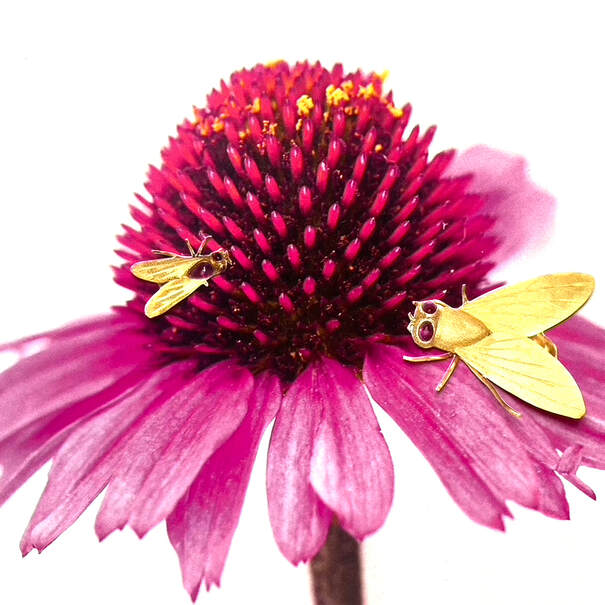 .As a gardener, you can do a lot to provide much-needed food and habitat to pollinators and other insects. Many of the following ideas require less of an effort than you might be putting in at the moment!
Random insect fact: Metamorphosing insects are the world's most successful ones - just four groups of them make up 65% of all known species on the planet (flies, bees/ants/wasps, butterflies/moths, beetles). Are your reading this in the cold season? Find out what you can do for insects in the winter! Source: Dave Goulson, Silent Earth - Averting the Insect Apocalypse
0 Comments
 Well, as a matter of fact, we don't have a clue what most insects do. There are an estimated 5 million insect species on the planet, and we've only named one fifth of them - about one million. However, if you look at what those we actually do know provide for us and the rest of the living world, it becomes clear that losing insect species is potentially catastrophic, even if their ecosystem function hasn't been discovered yet.
Let's take a look at some of the vital contributions insects make to our world:
With insect numbers in decline everywhere, all of these vital services are threatened. Luckily, every single one of us can take action to help boost insect populations, not only where we live but also in the rest of the world. If you don't know where to start, I suggest you watch this space - there will be a whole series of Precious Insects posts, starting with 5 simple things you can do for insects in winter. Fun insect fact: A favorite dish of Hirohito, the former Emperor of Japan, was boiled wasps with rice. Source: Dave Goulson, Silent Earth - Averting the Insect Apocalypse 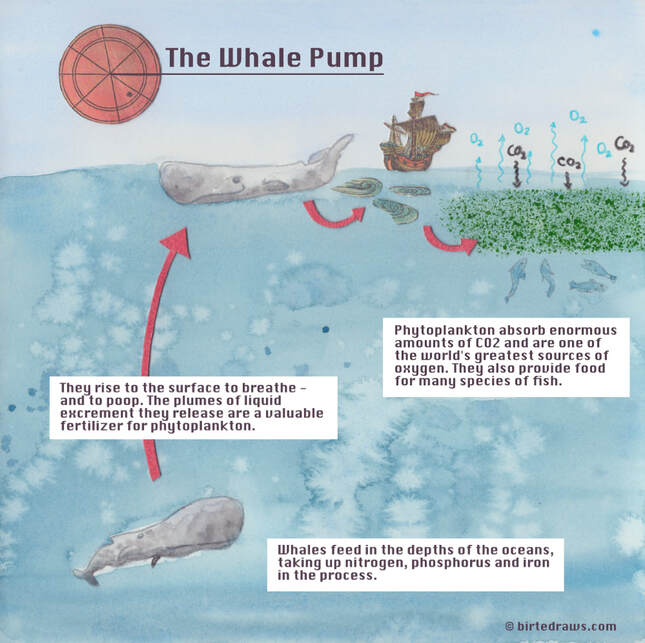 Did you know that the great whales have a vital role to play in storing carbon in the oceans? "When it comes to saving the planet, one whale is worth thousands of trees" according to the International Monetary Fund (IMF). One way they do it is by accumulating carbon in their bodies during their lifetime and taking it down to the bottom of the sea with them when they die, removing it from circulation for a very long time. However, their most important contribution to carbon storage is what is known as the "whale pump". By fertilizing the upper reaches of the oceans with nutrients from the depths, they promote the growth of phytoplankton. These tiny creatures capture an astounding 40 percent of all the CO2 produced in the world, turning it into at least half of the oxygen that is made available worldwide (IMF estimates).
Rewilding the oceans and protecting the great whales so that their numbers can increase again is therefore a natural, non-technological way of dealing with the carbon problem. It is estimated that if whale populations were to reach their pre-whaling sizes once more, they could capture 1.7 billion tonnes of CO2 annually, which is about the amount that Russia emits every year (Charles Clover). Sources and inspiration: Charles Clover: Rewilding the Sea - How to Save Our Oceans IMF: https://www.imf.org/en/Publications/fandd/issues/2019/12/natures-solution-to-climate-change-chami  We still have some time to go till spring, and insects are not much in evidence right now. But there is a lot we can do even during winter to make the world a more insect-friendly place. Here are a few simple but powerful things you can apply as of today.
Fun fact (even though you might also find this a bit scary): The weight of ants on our planet is similar to the total weight of all humans. Source: Dave Goulson, Silent Earth - Averting the Insect Apocalypse 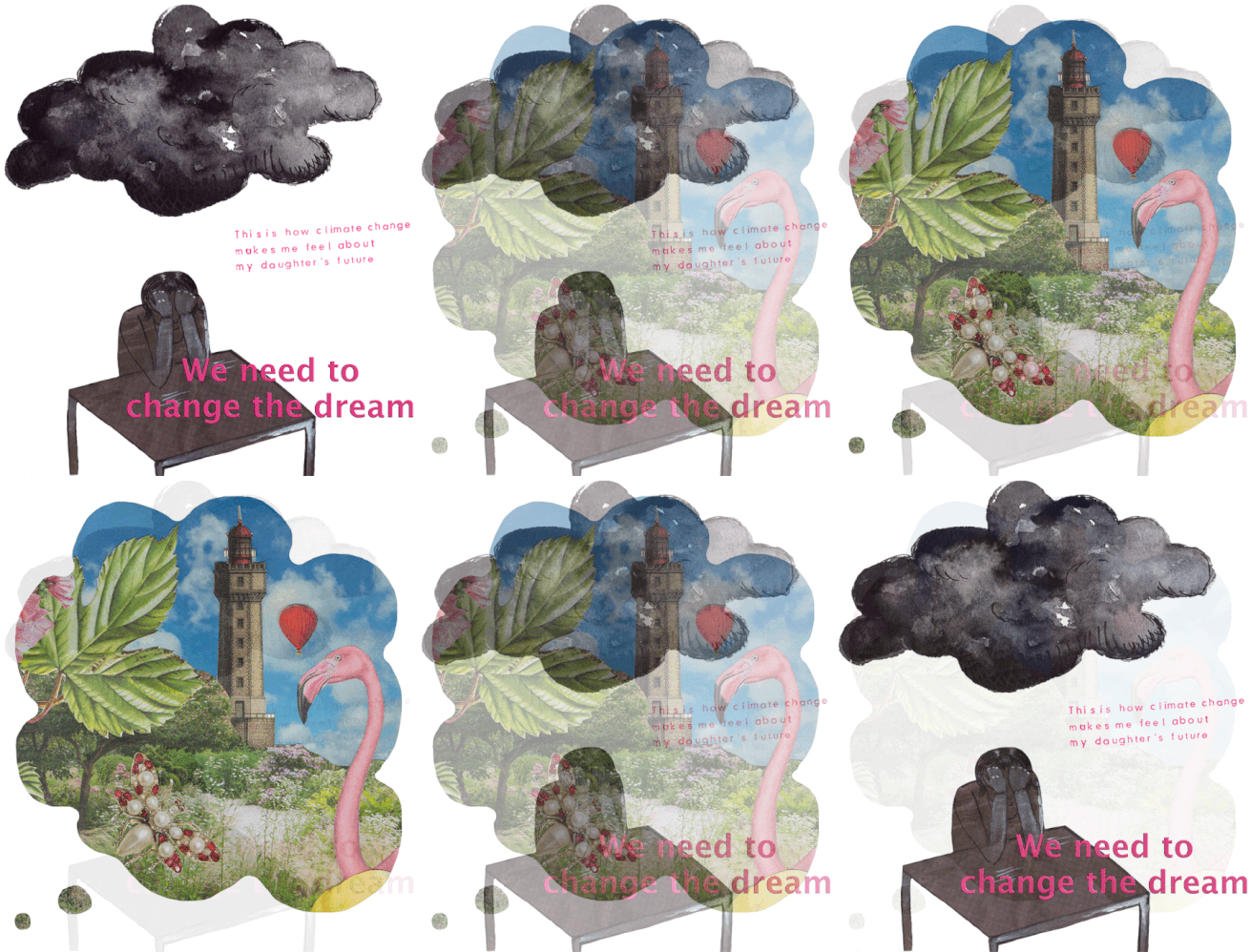 When you want to become more hopeful about your own life, it really helps to open up your ears to the silent dialog you have with yourself all day long, for example every time you look into a mirror. Many of us, particularly women, will hear themselves say things that suggest that there is something wrong with them, something lacking, that they are not enough just the way they are. It requires conscious effort to stop the flow of nasty remarks and try to look at ourselves with appreciation, but I know from personal experience that it can make a massive contribution to shifting your entire perception of who you are in the world. One of my favorite quotes is "The grass is greener where you water it." In other words, what we give our attention to grows. Unfortunately, this is true for both positive and negative things. If you focus on all that's wrong with your life, the negative things are going to grow and all that's positive is going to wilt without the water of your attention. We are what we think.
While I've been familiar with this pattern on a personal basis for a while, it didn't occur to me that you can apply it to the world at large, and to all the pressing issues that humanity is confronted with. Then I came across two very different books that both essentially argue that it is possible to reimagine the future - develop a new dream for the future - and that this is exactly what we need to do if we want to turn things around. In "The Soul of Money", Lynne Twist argues that we've been living the myth of scarcity for a very long time. We are all trapped in the thought pattern of there is not enough, more is better and that's just the way it is. Instead of appreciating what we have and living from a place of enough, we constantly chase after money and material goods to alleviate the sense of lack that permeates our lives. Interestingly, this is also true for very rich people. Even they never reach the state of enough unless they start looking at their lives from a perspective of sufficiency. Lynne Twist demonstrates that it is possible to overcome scarcity thinking and no longer let money dominate you, but make your money and the way you use it an expression of your deepest values. Once you realize that there actually are other ways to live, a different world becomes possible - a world in which there is enough for everyone, a "you-and-me world" instead of a "you-or-me world", as she calls it. A world in which "more" is no longer the paradigm would be a world without excessive consumption and the massive exploitation of the earth's resources caused by it. One of the central questions Rob Hopkins asks in "From What Is to What If - Unleashing the Power of Imagination to Create the Future we Want" is What if things turned out ok? It struck me when I read this that I was struggling to even admit this was a possibility. I believe that many of us are so overwhelmed by the probable impact of climate change that we get stuck in hopelessness and passivity. In that state of mind you will find it very hard to take positive action, because making a positive contribution requires having positive energy. Rob Hopkins shows in his book how harnessing the imagination and tapping into human creativity can restore hope to people and bring about rapid and unexpected change. A new dream for the world - or some part of the world surrounding you - is key because by imagining a positive future you bring this possibility into being. Focusing on a positive dream also frees up a lot of energy that would otherwise be spent worrying about all that's going wrong. Having a dream shows us which parts of our mental garden we need to be watering and which parts no longer deserve our attention. It inspires us to act in order to make the dream come true. What is a dream that you can start turning into a reality? Inspiration: Lynne Twist, The Soul of Money Rob Hopkins, From What Is to What If - Unleashing the Power of Imagination to Create the Future We Want |
Illustrated Thoughts
Hi, I'm Birte and I make (live) illustrations. This is where I express myself in words and images about topics that have made me think. Archives
February 2024
Categories
All
|
 RSS Feed